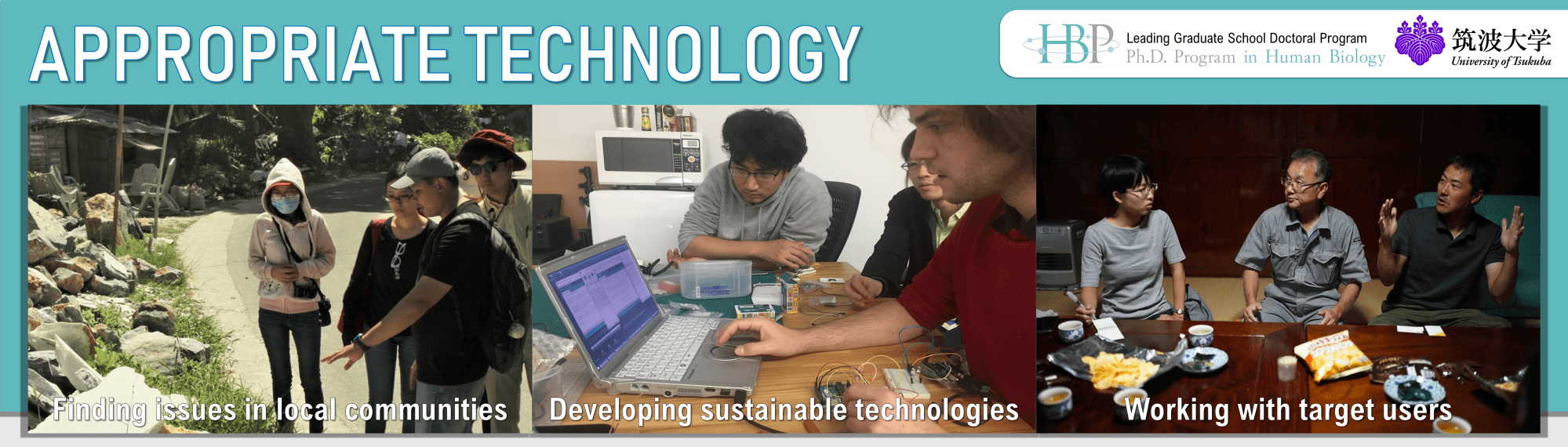
Appropriate Technology (AppTech) started at the University of Tsukuba in 2012. It aims to give its students a holistic experience of developing a simple and low-cost technology for their target community. The activities include preliminary research, connecting with the target community, field research, prototype development, and implementation.

Introduction to Appropriate Technology
These classes focus on group work dynamics and developing preliminary and field research skills. Some of the topics covered in this subject are:
- Appropriate technology for developing countries
- The concept of Quality of Life (QoL)
- Project notebook and record-keeping
- Conducting of preliminary research
- Communicating with the target community
- Persona-Empathy analysis
- Iceberg Model and Systems Thinking (mind mapping)
- Preparing a blueprint and the prototyping process
Learning contents:
[Topic 1] QoL and SDGs
[Topic 2] Problem Identification
[Topic 3] Design Thinking
Appropriate Technology
These classes focus on finding issues related to QoL and designing a possible and appropriate solution. Some of the topics covered in this subject are:
- Field research and consolidation (identifying your target users)
- Prototype development and testing
- Financial Management
- Developing a possible market (business model generation)
Learning contents:
[Topic 4] Persona-Empathy Map
[Topic 5] Technology Blueprint
[Topic 6] Fieldwork Preparation
[Topic 7] Theory of Change
[Topic 8] Proof of Concept and Design Kansei
[Topic 9] Technology Sustainability
[Topic 10] Co-working with Target Users
[Topic 11] Technology Transfer and Last Mile Strategies
[Topic 12] Starting a Business
Advanced Appropriate Technology
These classes focus on product development and its deployment to the target community. This subject serves as the application of everything that was learned in the course. Some of the topics covered in this subject are:
- Project management
- Product development
- Entrepreneurship Training
- Technology transfer and marketing
Course Summary Poster
Presented during the HyperInterdisciplinary Conference 2024 in Tokyo, Japan.
 AppTech